General News X Fishtrackers: “There’s Something Big in that Lake”
QUINTON, VA — Everyone who lives on a lake has a story. Whether you grew up here, are raising a family here, or just visit for the weekends, the legends are part of the landscape. There is always a “Moby Dick” that broke the line, a “swamp monster” lurking in the hydrilla, or the giant fish that could never be caught. And while no one truly believes “Gramps” had a literal gunfight with a swamp creature, there is a lingering sense that with every legend, there is a seed of truth.
This is not a ghost story. Nor is it one of those modern cryptid tales where a simple ripple on the water is transformed into a bloodthirsty beast. This is a matter of documented fact. However, in a quiet community like Woodhaven, a ten-foot catfish may as well be Godzilla.
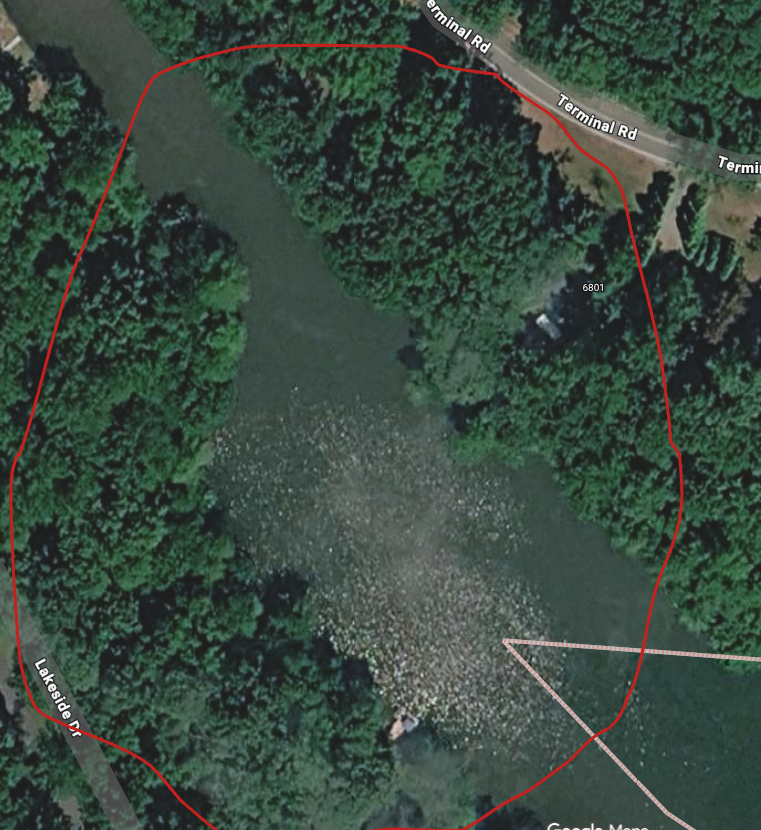
General Vicinity of the first incident.
The incident in question occurred recently with an anonymous, trustworthy witness. Her grandson was out on a boat in a secluded, murky pocket of the lake—a mini-bay fed by a local stream. The afternoon was quiet until the boy felt a violent yank on his line. He began reeling in hard, fighting a significant weight.
Suddenly, the fish jumped. Both witnesses confirm it was a massive Largemouth Bass, a trophy specimen weighing approximately 10 to 15 pounds. It was the catch of a lifetime.
Then, the physics of the fight turned dark. The bass dove back under, and with a quick, powerful jerk, the line went deep. “I thought the line would snap,” the boy claimed. “It was so strong, but before it could, the line released.”
When he reeled the line back in, the resistance was gone. It felt lighter, the fight had vanished, but there was still a sickening weight on the end. To his horror, he pulled up the gored, decapitated head of the bass. The 15-pound body had been severed clean off mid-fight.
“It had to be something very big,” says the witness. “We don’t see bass like that often. It’s one thing for a hawk to take one, but even then that’s unlikely—they usually go for easier, smaller fish. But for something underwater to? This is a new level.”
This account came directly from a personal interview with a friend of the family. Her normally kind, calm face was grave as she recounted the boy’s shock. “There’s something big in that lake,” she said. The warning was enough to cut my own kayaking trip short; being alone in a kayak as the sun dips below the trees, watching the murky water, becomes a different experience when you know what the depths are capable of.
Later that same day, the mystery deepened. Two other anglers fishing for bass under a cluster of overhang trees reported a sighting on the opposite bank. They described a massive ripple followed by a “tan shadow” moving through the water. Their description was chillingly grounded: “It looked like a log, maybe slightly bigger, but no smaller.”
The day after I heard this story from my friend, I interviewed both the witness, her grandson, and the two anglers. Both the anglers claim that this was easily big enough to rip off the bass’s body.
“Put together, width and length, it may well have been the size of your average kayak.”
This naturally immediately raised my curiosity. In a four day search, six hours a day and four at night, taking breaks for rest and food, I found nothing. But on my fourth and final day, just Wednesday the 15th, I found something chilling in the cove.
I cast a senko worm into the dark water, allowing it to rest undisturbed on the bottom. After ten minutes of silence, I felt a strike of such immense power that my rod was ripped from the kayak’s holder, snapping the cheap mount entirely. I lunged to grab the rod, the line screaming out with enough friction to leave burns on my hands.
Suddenly, the tension vanished. The line went slack, and in smooth, haunting movements, the creature began swimming directly toward the kayak. When it reached a distance of approximately ten feet, I realized the local warnings were true: a massive, kayak-like object was moving just beneath the surface. It was significantly thinner than my vessel but appeared just as long. As it approached, the creature seemed to panic; it bolted for the floor of the lake, and the heavy line snapped instantly. From my brief vantage point, it appeared to be a fish, yet I could discern no movement from fins or a tail.
Faced with a creature of that magnitude, I immediately backed away thirty feet, fully aware that an animal of that size possessed the mass to easily pull a kayak under.
The search for a biological identity reveals a few unsettling candidates within Virginia’s waters. In September 2024, a 57-pound snapping turtle nicknamed “Godzilla” was pulled from Henrico County’s Curles Neck Farm, setting an unofficial state record. While a massive common snapper is a possibility—and allowing for the fact that adrenaline can cause the mind to exaggerate—the sheer length of the shadow would imply a turtle of impossible proportions. A 250-pound Alligator Snapping Turtle, while theoretically capable of such a strike, would be an exceedingly rare anomaly in this region- and the world, which basically rules it out.
A highly plausible culprit is a catfish, specifically a Flathead or a Blue. Known as the “vacuums” of the river world, these reclusive giants can reach hundreds of pounds, growing large enough to swallow significant prey in a single gulp. One could easily have grown up in quiet backwaters or channels, or possibly traveled along other lakes.
A far less likely, yet fascinating, explanation is the Atlantic Sturgeon. These prehistoric fish frequent main channels to hunt but seek out shallow, secluded bays to make their homes. April and May mark their spawning season, yet the journey to Kent Lake would be arduous. The local dam lacks a fish ladder, meaning a sturgeon would have to leap the barrier during a significant rainstorm—a feat they are known for, but one that raises the question: of all the places to spawn, why here?
Alternatively, this could be a “pet” sturgeon. Across the United States from retailers(the closest legally shipped is in North Carolina, only an hour and a half’s drive from here), exotic fish like Siberian or Diamondback sturgeons are sold online for as little as $100. These fish, which can reach seven feet in length, are often bought by fishing pond owners for their size and strength as fighters. It is entirely possible that a specimen was released into the nearby Toe Inc Swamp or the lake itself by someone who could no longer care for it.
But why would such a monster appear now? One theory suggests that during mating season, a large predator may have traveled down from the Toe Inc Swamp. The geography provides a direct highway: Kent Lake empties into the Toe Inc Swamp. The Toe Inc Swamp feeds the Chickahominy. The Chickahominy feeds the James River, eventually reaching the Chesapeake Bay and then finally the Atlantic Ocean. It is technically possible for a giant to have migrated inland over the course of generations.
However, the most grounded explanation remains the Longnose Gar. While small Gar are native to the lake, often found under overhangs, they are known for a peculiar life cycle. They often mature in the total seclusion of murky, narrow creeks. Once they reach adult size, they suddenly and randomly migrate into main channels. To a witness on the water, it appears as though a monster has manifested out of nowhere, when in reality, it has simply been waiting in the shadows to grow large enough to claim the lake in some tiny, hidden creek.
However, this raises new questions. While a gar seems to fit the description in terms of sheer size—and a large catfish, perhaps in the 75+ pound range, remains equally plausible—there are behavioral inconsistencies that cannot be ignored. Gar are known for their tendency to surface and even leap, especially when startled or pursuing prey. In a situation like this, one would reasonably expect to witness some form of aerial movement or at least a disturbance breaking the surface. No such behavior has been observed.
A catfish presents a slightly different problem. Though far less likely to breach the surface, they are typically bottom-oriented, preferring to move along the lakebed rather than glide just beneath the surface in open water. That said, a mature flathead catfish remains a strong candidate, given its size, strength, and predatory nature.
In an effort to gather more concrete evidence, trail cameras have been deployed—both underwater and along the surrounding creeks. The underwater units have been positioned strategically along current lines, where movement is most likely to occur. Thus far, the footage has yielded only a bullhead and a bass. Nothing larger has appeared.